
What Is the 4Cs Diamond Grading System? A Beginner’s Buying Guide
You must know about the 4Cs diamond grading system before making any purchase. This system allows for a great understanding of the diamond and also an accurate assessment of the diamond’s characteristics. This is highly important for the long-term value as well as the current budget of your jewelry piece. The gem experts consider the diamond’s value and quality based on four characteristics.
The diamond industry refers to these four elements as the Four Cs: Cut, Color, Clarity, and Carat weight.
This beginner's guide gives you all the beginner-level descriptions of the quality standards of the diamond and professional tips about picking diamond jewelry for yourself.
1. Cut
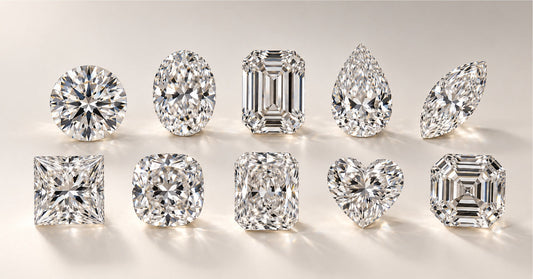
The cut is the most important aspect of the 4Cs diamond grading since it is noticeable and affects how the diamond shines and looks. The cut represents the shape of the diamond. There are various diamond shapes, including the classic shapes like round and baguette, and some more contemporary shapes like princess and radiant cut.
The quality of a diamond’s cut, and how it plays with light, is graded as follows:
- EXCELLENT
- VERY GOOD
- GOOD
- FAIR
- POOR
It is best to select a grade of cut that is rated GOOD or VERY GOOD, as these cuts will offer your diamond exceptional lightplay and brilliance, while making it affordable in the process. In case you haven’t made up your mind about the shape yet, the classic round one is a great choice to start with.
2. Color
The second standard in the 4Cs diamond grading system is colour. At first, this sounds contradictory because diamonds are usually clear. Still, in the case of low-grade diamonds, the yellow hue can be seen. The diamond’s colour is usually rated according to the system ranging from D to Z, with D being the highest grade, representing a diamond free from colour. In contrast, Z refers to significantly yellow diamonds.
Recommended color grade: For diamonds of 0.50 carats or below, use an H color grade. H diamonds fall within the white color spectrum and are virtually undetectable with the naked eye. Furthermore, this less expensive approach is a great way to save money.
3. Clarity
Clarity of a diamond is indicated by the presence of minute deposits of minerals or tiny cracks that diamonds are created with. The higher the clarity of a diamond, the fewer the inclusions, even though diamonds with inclusions are generally sold at lower prices.
We suggest that when you purchase your diamond, you should choose between the SI2, meaning Slightly Included, and VS1, which denotes Very Slightly Included, to get the best value for your money. This way, your jewelry doesn't have any blemishes or hazy spots in it, and isn't out of your budget either.
4. Carat
Now, carat is the weight of the diamond. The greater the number of carats, the more weight the diamond has. For example, a diamond weighing 100 points is equivalent to one carat, so it will be noted as 1CT upon purchase.
A diamond’s dimensions do not indicate its quality. So, a little diamond with high values in clarity and cut may be more precious than a huge diamond possessing lower values in all of its aspects. It is advisable to take into account the diamond 4Cs grading system before selecting the carat weight for your diamond.
Our suggestion: You should always treat carat weight as the last thing to consider. After the cut, colour and clarity have been determined, if your budget still allows it, you can proceed with increasing carat weight.
Standards To Consider Other Than The 4Cs Of Diamond
Apart from the diamond 4Cs chart, we like to remind diamond buyers about two further Cs: certificates and conflict-free diamonds. Some companies source their diamonds without authenticity and underpaid.
1. Certified diamonds
Upon acquiring a certified diamond, you will receive something called a diamond report or diamond certificate. This certification is provided by a gemmological laboratory like the IGI or GIA. This report basically confirms your ownership of the said diamond and confirms the grading of the 4Cs.
2. Conflict-free diamonds
Be sure to purchase diamonds that do not promote violence. This is to say, a conflict-free diamond should not originate from an illegal market, nor should it have been sold for profit by any group that is involved in initiating wars or violating the rights of individuals.
A Final Word: Get Your Top-Quality Diamond With Us
With the help of the 4Cs diamond grading system, you can ensure you make a smart purchase while staying within your budget. So choose a diamond that you can verify is ethically sourced and is in accordance with your budget. Be it natural or lab-grown diamonds, make sure to select the best one according to your requirements for your engagement ring or a pendant.
And if you want your journey to be smooth, visit T Bird Jewelers and meet our expert gemologists. We provide a comfortable environment for everyone, no matter if you are dropping by as a beginner for expert advice or want to buy from our extensive collection of top-grade jewelry.